RDF — rfxn Development Framework
Governance-driven AI development for teams that ship to production.
RDF is a convention governance layer for AI coding agents. It sits between you and the AI runtime (Claude Code, Codex, Antigravity CLI), encoding project conventions, quality gates, and domain expertise into typed agent personas — so the AI writes code that actually follows your rules.



6 agents · 37 commands · 13 profiles · 5 adapters · 7 modes
Quickstart — 5 minutes View on GitHub
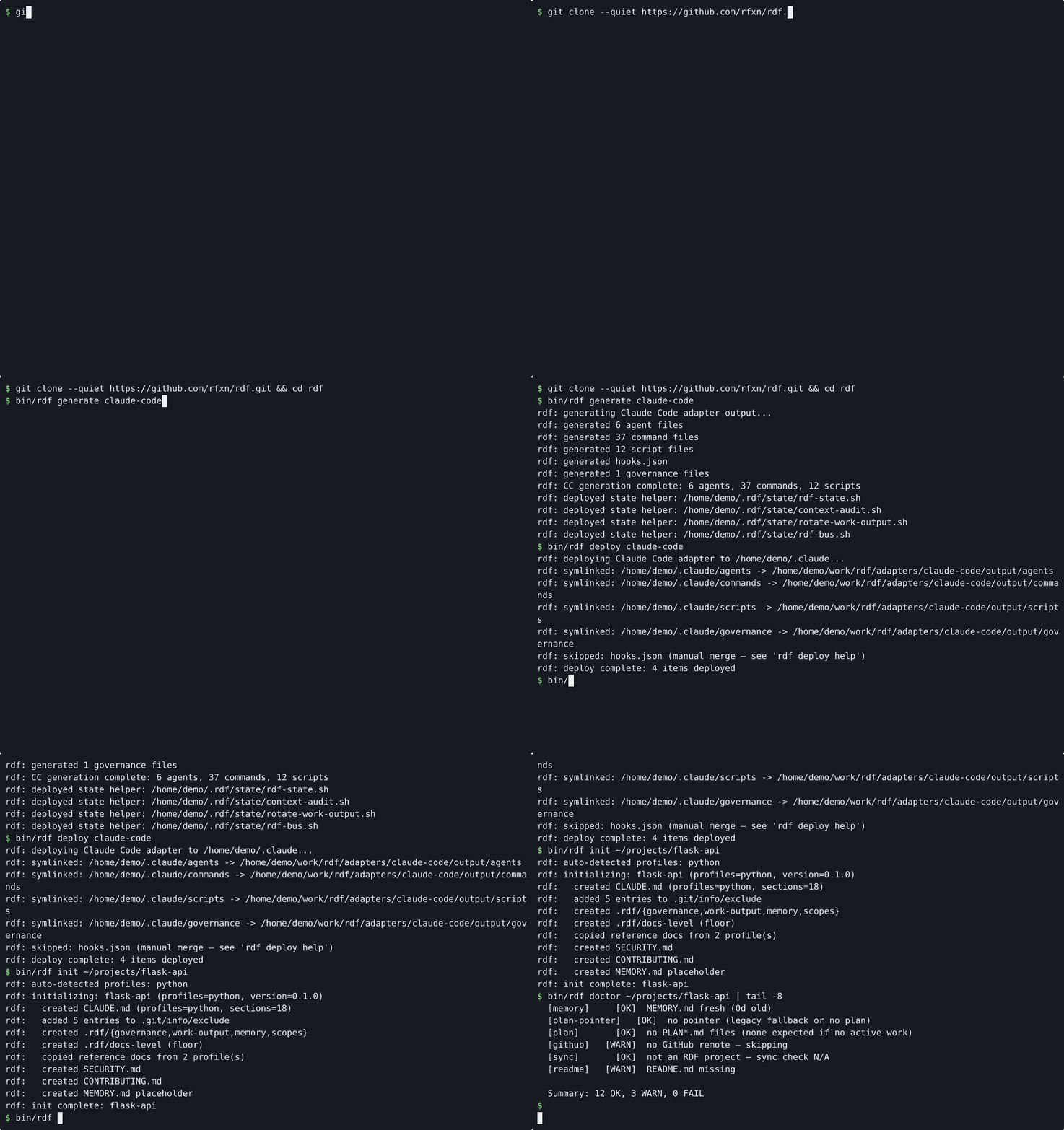
Real recorded session — install RDF, initialize a plain Flask project, verify health. 42 seconds, no edits, ends at 0 FAIL.
Install
As a Claude Code plugin (one command, commands namespaced /rdf:r-*):
/plugin marketplace add rfxn/rdf
/plugin install rdf@rdf
Plugin-only installs run in a degraded mode for the 10 state-backed commands (r-spec, r-plan, r-build, r-ship, r-status, r-save, r-refresh, r-context-audit, r-vpe, r-util-mem-compact): the full session-state machinery needs the ~/.rdf/state/ helpers that only the symlink deploy below populates. See multi-tool parity.
Or symlink deploy (contributor mode, bare /r-* commands):
git clone https://github.com/rfxn/rdf.git ~/rdf && cd ~/rdf
bin/rdf generate claude-code && bin/rdf deploy claude-code
bin/rdf init ~/projects/my-app     # auto-detects your stack
Each command deploys as its own ~/.claude/skills/<name> directory symlink (output/skills/<name>/SKILL.md per adapter). Hooks auto-register on the plugin install; the symlink deploy requires a manual merge of adapters/claude-code/hooks/hooks.json into ~/.claude/settings.json (see rdf deploy help). Hooks and the status line require jq on your PATH. Context cost is published and CI-guarded: the default deploy adds ~0.1K always-loaded tokens per session (~2.1K with opt-in scoped rules, ~0.7K for rdf-lite). Full walkthrough with real output: Quickstart.
The pipeline
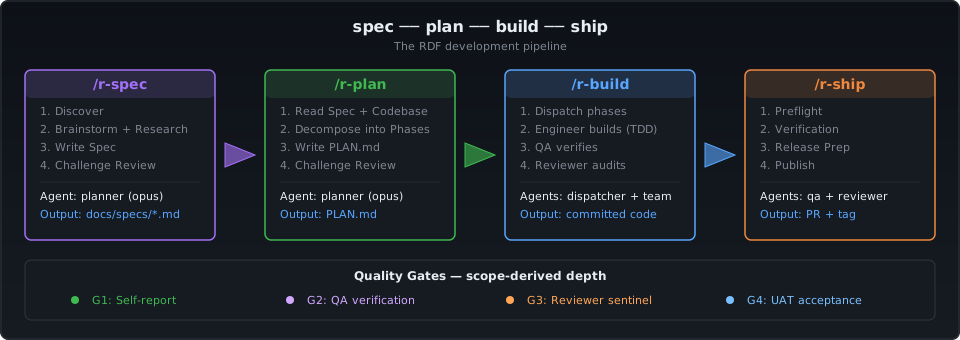
Four commands take a change from idea to release — /r-spec (research + adversarial design review), /r-plan (execution-grade decomposition), /r-build (TDD with quality gates), /r-ship (preflight → publish). Small change? Skip the pipeline — governance applies to normal sessions too.
Why RDF
| Principle | What it means |
|---|---|
| Governance as code | Conventions live in versioned files the AI reads every session — not in your head or a wiki |
| Adversarial quality gates | Reviewer agents challenge specs before implementation and audit code after it, with scope-derived depth |
| Convention inheritance | project → workspace → profile → core layering (most specific wins); one edit propagates everywhere |
| Multi-adapter | Author governance once; deploy to Claude Code (symlink or plugin), Codex, Antigravity CLI, Gemini CLI (legacy), or plain AGENTS.md |
Proven on production infrastructure
RDF governs the development of security tooling running on ~350,000 servers (APF, LMD, BFD). Measured across the RDF era (March–July 2026, derived from session logs and git history):
- 518 governed sessions across 30+ projects at a sustained ~4.3 sessions/day, landing 2,513 git-verified commits
- Three major releases shipped under governance — LMD 2.0, APF 2.0, BFD 2.0 — plus 26 RDF releases in 18 weeks
- 6,871 BATS tests across 13 governed repos, all CI-runnable
- Every release backed by committed design specs (25) and implementation plans (22) — we design in the open: spec archive
Docs
- Quickstart — your repo in 5 minutes
- Demo walkthrough — a real production change, spec to ship
- Multi-tool parity — Claude Code, Codex, Antigravity (+ Gemini legacy)
- Memory & context — RDF alongside native auto-memory
- Full command reference (README)
- Roadmap
Get involved
Issues · Discussions · Contributing · Security policy · Privacy policy