Pipeline and quality gates
Spec-driven development for AI coding agents: design first, plan in phases, build with TDD, and release only with evidence.
- The four stages
- Pick a tier
- Quality gates
- Review without the pipeline
- Audit a whole codebase
- See it run
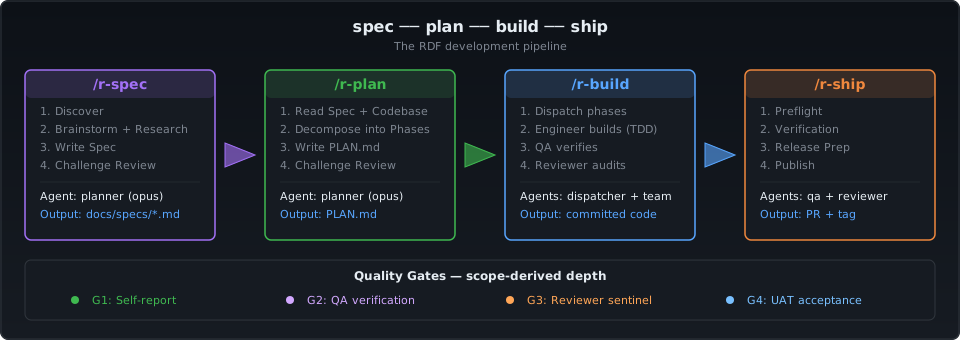
The four stages
| Stage | Command | What happens | Output |
|---|---|---|---|
| Design | /r-spec | Discover the problem, research options, write the spec, run a challenge review | docs/specs/*.md |
| Plan | /r-plan | Read the spec and code, decompose into TDD phases, run a challenge review | docs/plans/*-plan.md |
| Build | /r-build [N\|--parallel] | The dispatcher runs each phase: engineer implements, QA verifies, reviewer audits | Committed code |
| Ship | /r-ship | Preflight, verification, release prep, publish, report | Pull request |
Enter at any point. Have a spec already? Start with /r-plan. Have a plan? Start with /r-build. Each command tells you the next step.
/r-vpe is an optional orchestrator that runs the whole pipeline from one outcome-oriented request.
Pick a tier
Not every change deserves the full process. Choose a tier at /r-spec or /r-plan. RDF suggests one from the request, you confirm it, and pressing Enter keeps --full.
| Flag | Use it for | Spec | Plan review | Build gates |
|---|---|---|---|---|
--full (default) | Multi-component work or open design questions | docs/specs/*.md | Challenge review | Set by scope (below) |
--quick | Well-understood changes to about 3 files, with no open architecture questions | Condensed | Single review | Gate 3 capped at sentinel-lite |
--bugfix | A defect you can reproduce with a test | None, the failing test comes first | Schema check only | Gate 1 plus a regression-only sentinel-lite |
A five-line fix is just /r-plan --bugfix, then /r-build.
Tiers only remove ceremony, never safety. Security-sensitive changes keep QA and the full 3-pass review whatever the tier. Details: canonical/reference/tiers.md.
Quality gates
The dispatcher derives verification depth from what each phase touches, so you never tag a phase by hand.
| Gate | Who runs it | What it checks |
|---|---|---|
| 1 | Engineer | Self-report with evidence |
| 2 | QA (rdf-qa) | The project checks in governance/verification.md: lint, tests, anti-patterns |
| 3 | Reviewer sentinel (rdf-reviewer) | Adversarial review. Lite is 2 passes (anti-slop, regression); full adds security |
| 4 | UAT (rdf-uat) | Real-world scenarios, install flows and CLI use from an end-user persona |
| Scope | The phase touches | Gates |
|---|---|---|
scope:docs | Documentation, changelog or comments only | 1 |
scope:focused | One file, or only config and scaffolding | 1, 2 |
scope:multi-file | Two or more source files (the default when scope is unclear) | 1, 2, 3 lite |
scope:cross-cutting | Install scripts, CLI entry points, cross-OS logic, breaking changes | 1, 2, 3 full |
scope:sensitive | Security-critical paths, shared libraries, data migration, credentials | 1, 2, 3 full |
Gate 4 is added at any scope when a phase changes CLI entry points, help text or man pages. Files named in your governance/constraints.md and governance/anti-patterns.md raise the scope, so your own rules steer the gates.
A --full plan with 3 or more phases also ends with a full 3-pass sentinel review of its cumulative diff.
Review without the pipeline
Every gate is available on demand:
| Command | Use it to |
|---|---|
/r-verify | Run a QA pass on a diff or scope |
/r-review --challenge <file> | Challenge a spec or plan before implementation |
/r-review --sentinel | Audit finished work (2 or 3 passes) |
/r-review-answer | Route findings to fix, rebut or defer, with an audit trail |
/r-test | Run user acceptance tests from an end-user persona |
Audit a whole codebase
| Command | What it does | Output |
|---|---|---|
/r-audit | Three reviewers and QA across all domains, in parallel | AUDIT.md |
/r-audit-slop | Finds dead code and orphan helpers, then a sentinel peer-reviews findings to remove false positives | Validated findings |
See it run
The demo walkthrough follows a real production change through every stage, with the actual gate results.