Profiles and modes
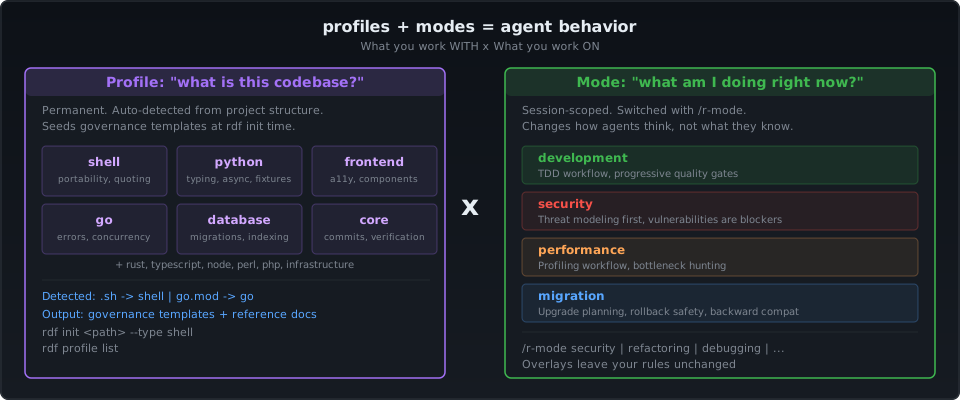
A profile says what the code is. A mode says how you are working right now. They compose independently, which is why the same agents behave differently on a bash firewall and a Python pipeline.
Profiles
Profiles seed governance for a stack. rdf init detects them from project structure, and they stay with the project. Several stack automatically on multi-domain repositories:
rdf init ~/projects/app                          # auto-detect
rdf init ~/projects/app --type rust,infrastructure   # force a set
rdf profile list                                 # see what is available
| Profile | Covers | Security focus | Refs |
|---|---|---|---|
| core | Commit protocol, verification, AI agent discipline (always active) | Secrets, input validation, injection defense | 4 |
| shell | Quoting, portability, error handling, process management | Command injection, TOCTOU races, SUID confusion | 3 |
| python | Typing, packaging, fixtures, async patterns | Deserialization, SSRF, import hijacking | 3 |
| frontend | Components, a11y (WCAG 2.1 AA), CSS, performance | XSS, CSRF, CSP, auth token storage | 4 |
| database | Schema design, migration safety, query discipline | SQL injection, least privilege, RLS | 4 |
| go | Error handling, concurrency, interfaces, modules | Race conditions, TLS config, deserialization | 3 |
| rust | Ownership, error handling, unsafe discipline, cargo | Unsafe without invariants, yanked crates | 3 |
| typescript | Strict mode, async discipline, Node.js backend | Prototype pollution, dependency confusion | 3 |
| node | Module-system discipline, async patterns, npm hygiene | Governance template only | 0 |
| perl | strict/warnings, three-arg open, regex security, taint mode | Regex DoS, taint bypass, injection via open() | 3 |
| php | strict_types, PSR, parameterized queries, Laravel and Symfony | SQL injection, deserialization, SSRF, CSRF | 3 |
| infrastructure | Terraform, Kubernetes, Ansible, secrets, CI/CD | State file exposure, secret sprawl, RBAC drift | 3 |
| rfxn-workspace | R-fx Networks org overlay, opt-in only and never auto-detected | Shared-library release workflow, consumer verification | 1 |
Refs counts the reference docs copied into .rdf/governance/reference/. Detection signals live in profiles/detection-rules.md.
Modes
Modes are session-scoped overlays. They change how agents think, and the only governance edit is the Mode: line in .rdf/governance/index.md. Switch with /r-mode <name>:
| Mode | Use it for |
|---|---|
development | The default TDD workflow: features, bug fixes, refactoring |
security | Threat modeling, vulnerability analysis, hardening |
performance | Profiling, optimization, bottleneck analysis |
migration | Upgrades, platform moves, data transforms |
refactoring | Large restructuring and code movement, preserving behavior |
debugging | Hypothesis-driven bug hunts, incident response, root cause analysis |
documentation | Read-then-write work: README rewrites, API docs, man pages, guides |
Short aliases work too: dev, refactor, debug and docs.
Modes affect gates. In security mode, for example, the security review pass becomes blocking.
Which rules win
The most specific rule wins:
project CLAUDE.md > workspace CLAUDE.md > profile defaults > core defaults
A project rule overrides a profile default, and a workspace rule overrides core. See Configuration for the files involved.